
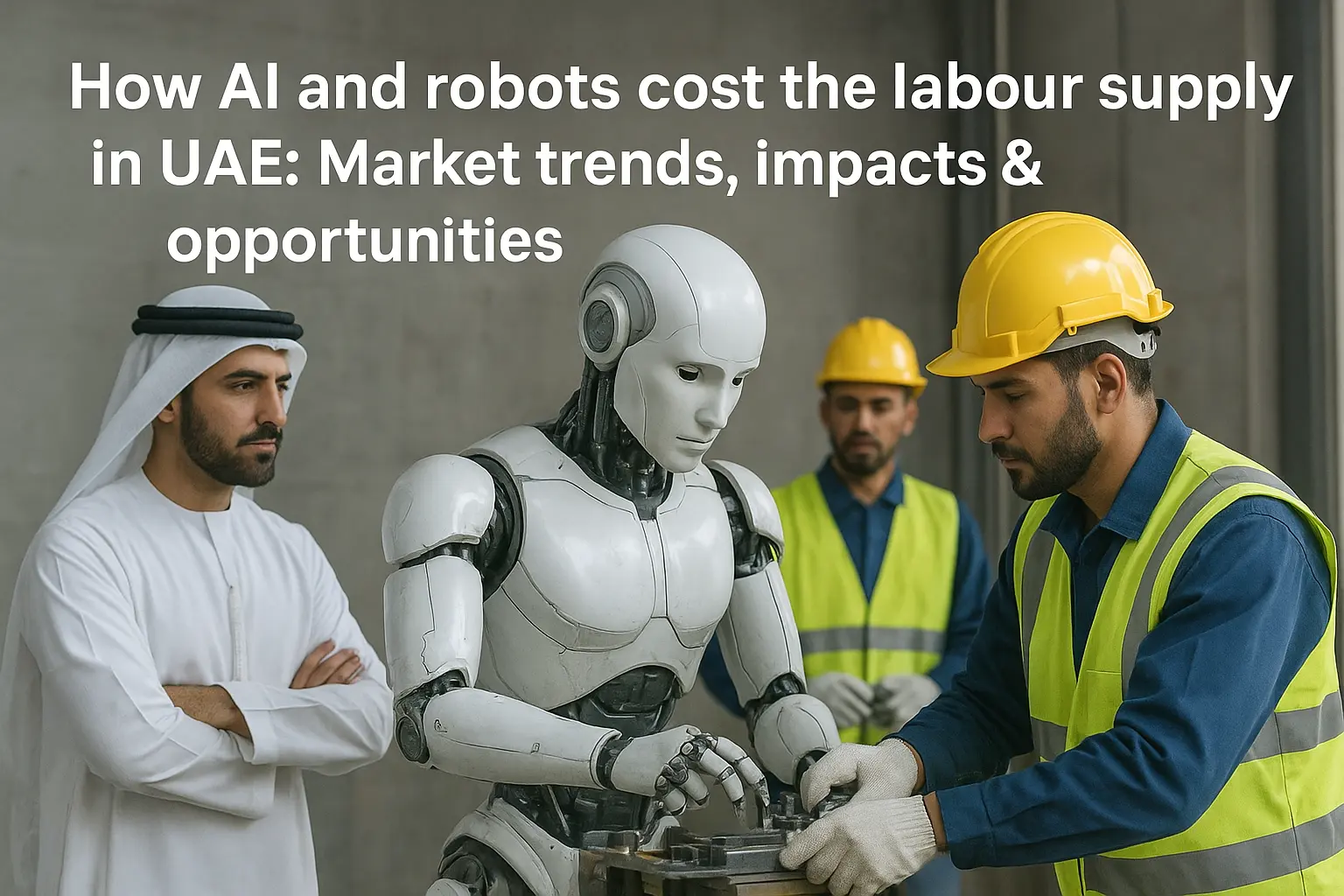
In the rapidly evolving UAE economy, the issue of AI and robots cost the labour supply in UAE is becoming increasingly important. As automation, artificial intelligence (AI) and robotics transform business operations across manufacturing, services, and government sectors, the labour supply in the UAE is being reshaped. This blog explores how AI and robots cost the labour supply in UAE, what market trends are driving this change, how different sectors are impacted, and what strategies workers, businesses and policymakers must embrace. By understanding the dynamics of how AI and robots cost the labour supply in UAE, readers will be better positioned to navigate the changing employment landscape.
The UAE’s Automation & AI Context
Strategic push for AI & robotics
The United Arab Emirates has made ambitious moves to become a global leader in artificial intelligence and robotics. Government strategies, such as the national AI strategy, and massive investment in research and development, infrastructure and education underpin this approach. For example, the robotics and automation industry in the UAE is projected to grow to USD 333 million by 2028, up from USD 213.5 million in 2024. With such a strategic focus, it is inevitable that AI and robots cost the labour supply in UAE will emerge as a major theme.
Labour supply & automation concerns
When organisations adopt AI and robotics, work that was traditionally done by humans begins to shift. The concept of labour supply changes: what skills are required, how many people are needed, and how jobs are designed. One report warns that as many as 25 % of work tasks in the UAE may soon be automated. This leads directly to understanding how AI and robots cost the labour supply in UAE — not necessarily only by job losses, but by change in the supply of human labour and its value.
Rising labour costs, productivity pressures & automation incentives
Part of the reason businesses accelerate automation is rising labour cost, combined with competitive pressures and the drive for productivity. For instance, in the smart manufacturing sector of the UAE, rising labour costs are cited as a driver of adoption of AI-powered robotics. In this context, the phrase AI and robots cost the labour supply in UAE highlights that human labour becomes more expensive relative to machines, which shifts how labour supply is valued, shaped, and utilised.
How AI and robots cost the labour supply in UAE – Sector-by-Sector
Manufacturing & industry
In the manufacturing sector, human labour for repetitive tasks—assembly, inspection, packaging—is increasingly supplemented or replaced by robots with AI capabilities. The UAE market for AI-powered smart manufacturing and robotics analytics is estimated at USD 215 million in 2024. As this technology becomes more widespread, AI and robots cost the labour supply in UAE by reducing the number of workers needed for certain roles, whilst increasing the need for higher-skilled labour.
Services, retail & hospitality
In services and retail, automation via AI and robots is gaining traction. For example, the UAE AI-powered retail robotics market is estimated at USD 1.2 billion, focusing on inventory management, customer service, and checkout automation. These developments mean fewer entry-level roles may be required, or the roles will change in nature — again illustrating how AI and robots cost the labour supply in UAE in shifting the types of jobs and the number of human workers needed.
Government / administrative functions
The public sector in the UAE is also leveraging automation and AI to streamline operations. One reported initiative is the use of robots (software/robotic process automation) in public services to handle thousands of transactions in minutes instead of days. In such contexts, AI and robots cost the labour supply in UAE by reducing demand for traditional administrative human labour and changing the nature of government employment.
Emerging areas: healthcare, construction, logistics
Beyond traditional sectors, emerging uses of robotics and AI in healthcare (robotic surgery, diagnostics), construction (robotic construction assistants), and logistics (automated warehouses) also have implications for labour supply. These sectors underscore that AI and robots cost the labour supply in UAE not just by replacing older jobs, but by creating new roles, shifting tasks, and redistributing human labour.
What “Cost” Means for Labour Supply
Displacement & shift
The most visible cost is displacement—human workers whose tasks are automated may lose jobs or have their roles significantly altered. A survey found 55 % of UAE workers worry their roles will be replaced by AI or robots within the next decade.
Wage pressure & skills premium
As routine tasks are automated, human labour that remains or is newly demanded shifts toward higher-skill roles. This changes wage structures, where wages for low-skill roles may stagnate and premiums rise for tech-oriented roles. This dynamic is central to how AI and robots cost the labour supply in UAE—the human labour supply must adapt to survive and flourish.
Human capital investment & upskilling cost
For the labour supply to remain relevant, workers must invest in new skills (AI literacy, robotics maintenance, data analytics). The time and cost of these transitions are real. Employers and policymakers also bear costs. Hence, the phrase AI and robots cost the labour supply in UAE captures the investment required by the labour force and the system.
Opportunity cost and mismatch
If labour supply does not adjust, there is a mismatch: too many workers with outdated skills, too few with future-ready skills, job vacancies unfilled, and human-machine roles under-exploited. That mismatch is a cost. In the UAE context, this means workers may face unemployment or underemployment, businesses may face talent shortages—even as automation accelerates.
Social & psychological cost
Though less tangible, human workers undergoing job shifts or displacement may face stress, loss of identity, diminished career prospects. The labour supply cost here is a social challenge in the UAE context, where workforce stability and employment are key. The statement AI and robots cost the labour supply in UAE thus also touches on human and societal cost.
Market Trends & Data in UAE
Growth of robotics & automation market
Several data points illustrate the speed of change: the professional-services robotics market in the UAE generated USD 152.1 million in 2024 and is projected to reach USD 284.5 million by 2030 (CAGR ~10.7 %). Meanwhile, the smart-manufacturing robotics analytics market is valued at USD 215 million. These figures highlight that automation uptake is real and growing—and thus the implications of AI and robots cost the labour supply in UAE are very present.
Workforce perception & skills adoption
A relevant survey found that 67 % of UAE employees believe AI will significantly alter work in the next year, with 72 % expecting major changes in five years. Also, a Kaspersky study found 76 % of UAE employees believe robots should be used more widely—and 89 % believe robots will replace humans in their industry. These perceptions reinforce the sense that the labour supply in the UAE is bracing for change—again underlining how AI and robots cost the labour supply in UAE is not a theoretical phrase but a lived reality.
Job roles and skills demand
Reports show that AI, data, digital roles are among the fastest growing in the UAE, and many companies are reskilling employees to work alongside AI. The shifting demand for skills means labour supply has to align with new roles—if it fails, then the cost of mismatch emerges.
Automation share of tasks & workforce implications
The report that up to 25 % of work tasks may be automated in the UAE within a relatively short time frame (next few years) is significant. When a quarter of tasks are at risk of automation, the labour supply demand will shift accordingly—and thereby the phrase AI and robots cost the labour supply in UAE plays out in terms of task realignment, workforce size adjustments, and job design changes.
Strategic Implications for the UAE Labour Supply
For workers
Workers in the UAE must understand the dynamics of how AI and robots cost the labour supply in UAE so they can adapt proactively. Key strategies include upskilling (AI literacy, robotics awareness, digital skills), focusing on human-centric skills (creativity, leadership, emotional intelligence), and being flexible in career paths—moving from roles likely to be automated toward roles that machines cannot easily replace.
For employers & businesses
From a business perspective, the cost of labour supply is changing. Employers should evaluate which human tasks can be automated, redesign job roles for human-machine collaboration, support workforce transitions with training, and anticipate changes in the availability and cost of labour supply. Recognising how AI and robots cost the labour supply in UAE will be critical for future-proofing workforce planning.
For policymakers & training institutions
At the policy level, ensuring that labour supply remains relevant is essential. Governments and training institutions in the UAE must invest in workforce development, facilitate transitions, support reskilling, and oversee that the shift driven by AI and robotics does not leave large segments of the labour supply behind or create systemic unemployment. Addressing how AI and robots cost the labour supply in UAE is as much about social policy as technology policy.
For the broader economy
The transformation of labour supply has macro implications: productivity gains, competitiveness, the shift in the composition of labour markets (from low-skill/high-volume to high-skill/low-volume), and changing wage dynamics. For the UAE economy, managing the cost to the labour supply of AI and robots will be vital to maintaining growth, social stability and a diversified workforce.
Challenges & Risks
High investment/uptake cost
Although automation offers labour cost savings, the initial investment in robotics/AI is significant for many firms, especially SMEs. For example, the retail robotics market in the UAE highlights high upfront costs as a barrier. The cost to the labour supply here is indirect but real: if businesses delay automation, labour supply may lag; if they rush without proper planning, workers suffer.
Skills gap & mismatch
Despite high ambition, many workers and businesses are not yet fully prepared. Skills gaps persist. The report on roles growing in AI/digital shows this challenge. If labour supply cannot adapt, then the cost of automation is magnified.
Uneven sectoral impact & labour supply segmentation
Not all sectors or job types will be equally affected. Some may see rapid automation (e.g., admin, manufacturing), others slower (e.g., creative, relational industries). The labour supply cost will therefore be uneven—some workers may lose out more than others. Recognising how AI and robots cost the labour supply in UAE requires sector-specific analysis.
Social/ethical risk
Job displacement, wage polarization, reduced employment opportunities for some groups—these are real risks. If the labour supply is not managed effectively, the cost to individuals and society can be high. The earlier survey showing 55 % of workers concerned about job replacement by AI or robots underscores this.
Over-reliance or mis-calculation
There is also a risk of assuming robots/AI will replace too many jobs too fast. Real work tasks may not be fully automatable, or human-machine collaboration may take longer to mature. If labour supply is incorrectly planned based on over-optimistic automation, the cost will show up in workforce misalignment.
Opportunities for Labour Supply
New high-skill roles
Despite the costs, there is an opportunity: new roles are emerging. For example, it is estimated that 97 million new jobs globally may be created by AI, including roles such as AI trainers and robotics specialists. For the UAE, this means labour supply that adapts can move into higher-value roles, reducing the net cost of automation.
Human-machine collaboration
Rather than viewing automation as replacement, many firms are adopting human-machine collaboration models: humans overseeing robots, interpreting AI outputs, focusing on tasks machines cannot perform. This shift means the labour supply can remain relevant and increase in value—not just shrink. The phrase AI and robots cost the labour supply in UAE then takes on a more nuanced meaning: cost in the old model, but opportunity in the new.
Productivity & redeployment of labour supply
Automation can free human labour from repetitive tasks so that it can be redeployed to more strategic, creative, interpersonal work. The labour supply becomes more skilled and more valuable. If managed properly, the cost to labour supply of AI and robots is offset by high-value labour supply roles.
Upskilling, lifelong learning advantage
This era demands that the labour supply in the UAE adopt lifelong learning, continuous upskilling, and adaptability. For workers willing to invest, this creates a competitive advantage. The cost of failing to do so is high—but the reward is a more future-proof career.
Practical Steps for Workforce & Businesses in UAE
For workers
Start by conducting a skills audit to identify which of your current tasks might be automated, then invest in training that builds your understanding of AI fundamentals, data literacy, and robotics awareness. Strengthen uniquely human capabilities such as creativity, leadership, emotional intelligence, and complex problem-solving—skills that technology cannot easily replace. Actively network and align your career path with emerging roles like robotics technician, AI specialist, or automation manager. Finally, stay informed about labour market trends in the UAE, where AI and robotics are reshaping workforce dynamics, and adapt proactively to remain competitive.
For employers
Begin by mapping your workforce tasks to determine which can be automated and which remain human-essential. Plan for change strategically—rather than simply replacing labour with robots, focus on redefining roles and fostering collaboration between humans and machines. Invest in training and transition programs to help affected workers shift into new, value-adding positions instead of exiting the workforce. Align your hiring practices with the evolving labour supply, as future demand will centre on new skill sets—businesses that ignore this risk talent shortages and rising labour costs. Finally, continuously monitor and respond to how AI and robotics are influencing the labour supply within your business and across the UAE’s industries.
For policymakers & training institutions
Ensure training programmes are aligned with future labour demand in areas such as AI, robotics, data, and human–machine collaboration. Support workforce transitions through subsidies, upskilling grants, and career transition services that help workers adapt to technological change. Maintain robust labour market data systems to monitor how automation is reshaping labour supply, job categories, and wage structures. Finally, promote inclusive growth by managing the impact of automation carefully, ensuring that vulnerable segments of the workforce are not left behind in the shift toward a more automated economy.
Looking Ahead – What to Expect by 2030 & Beyond
By 2030, the UAE’s labour supply landscape will look markedly different as automation becomes more deeply embedded across manufacturing, services, and administrative functions, making its cost to human labour increasingly visible. Many routine tasks will be fully automated, causing the labour supply for such roles to shrink or shift, while hybrid roles—where humans work alongside machines—will dominate key sectors. Wages for traditional manual and entry-level positions may stagnate, whereas high-skill, technology-oriented roles will command significant premiums. Without rapid skills adaptation, labour supply mismatches could intensify. For an economy focused on productivity and diversification, understanding how AI and robotics reshape the labour supply will be crucial for maintaining competitiveness, employment, and social stability.
Summary & Take-aways
Throughout this discussion, the phrase “AI and robots cost the labour supply in the UAE” captures multiple interconnected realities—role displacement, task transformation, shifting labour cost structures, the growing need for new skills, and the opportunities that arise when workers and businesses adapt. Automation is not merely about job loss but about reconfiguring labour supply: fewer workers in some areas, more in others, and an evolving demand for different competencies. While the cost to human labour is undeniable, so too are the opportunities for those willing to upskill. Employers and policymakers must therefore design strategies that account for these shifts through reskilling, role redesign, and inclusive transitions. The UAE’s labour market is experiencing a structural evolution, where the supply of human labour must adapt in size, structure, skill, and value. Ultimately, success will depend on anticipation, adaptation, and alignment—across the workforce, businesses, and the broader economy.